Five years of turning aerospace innovation into reality

Five years ago, GKN Aerospace opened its Global Technology Centre in Bristol to help turn promising aerospace technologies into something that can be built, demonstrated and ultimately flown.
The 10,000 m² centre was created through a joint £32 million investment by GKN Aerospace and the UK Government, through the Aerospace Technology Institute. It brings together industry, universities and research organisations to develop and test technologies for future aircraft.
Bristol is one of four GKN Aerospace Global Technology Centres, alongside Trollhättan in Sweden, Hoogeveen in the Netherlands and Fort Worth in the US. Each brings together specialist expertise and regional partners to address different aerospace challenges.
Making future aircraft lighter
Weight matters in aviation. Lighter aircraft structures can improve efficiency, but new designs and materials must also be practical to manufacture at the scale, quality and rate required by the aerospace industry.
Through Airbus’s Wing of Tomorrow programme, GKN Aerospace manufactured three full-scale Fixed Trailing Edge assemblies at Bristol GTC. The work advanced forming, infusion, curing and assembly processes for large composite structures.
The four-year ASCEND programme addressed a related challenge: how to manufacture composite aircraft structures at higher rates. Led by GKN Aerospace, it brought together 16 partners to explore new materials, processes, automation and digital technologies.
Together, Wing of Tomorrow and ASCEND helped bridge the gap between promising research and manufacturing methods that can be demonstrated at meaningful scale.
Bringing electric flight to life
Electric aircraft present a different challenge. New electrical systems and aircraft structures need to work together as part of a complete aircraft.
Vertical Aerospace’s all-electric VX4 demonstrator was assembled at the Bristol GTC. GKN Aerospace designed and manufactured the aircraft’s electrical wiring system, with the airframe assembly and installation of the system completed in Bristol.
Bringing the structures and electrical systems together in a physical demonstrator made it possible to see how the different technologies worked as part of an aircraft, rather than only as individual components.
Advancing hydrogen-electric propulsion
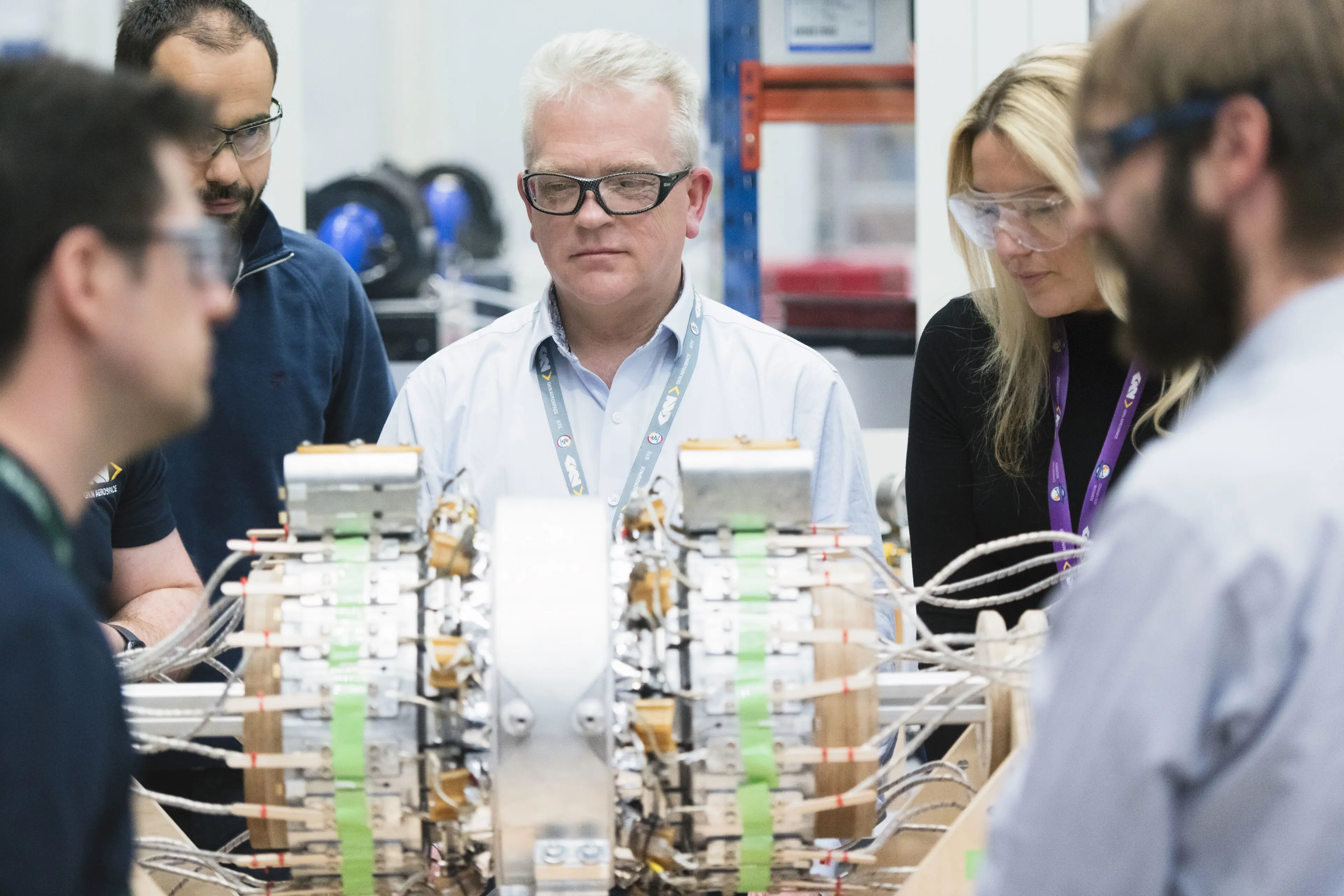
H2GEAR, a £54 million GKN Aerospace-led collaborative programme delivered from Bristol GTC, developed technologies for hydrogen-electric flight. The work explored how hydrogen can be used to generate electrical power for an aircraft, and how that power can be managed and distributed to the propulsion system.
While H2GEAR has now completed, the work continues. Technologies and capabilities developed are being taken forward through H2FlyGHT in the UK and ICEFLIGHT in the Netherlands. The aim is to enable hydrogen-electric propulsion as a potential route to zero-carbon flight.
From ideas to flight
Wing of Tomorrow, ASCEND, the VX4 and H2GEAR address different needs, but they illustrate the same principle: new aerospace technology has to work beyond the research environment.
That means building at full scale, proving new systems and understanding what is needed to take promising technologies towards future aerospace applications.
Five years on, this remains the purpose of the Bristol GTC: turning promising ideas into technologies that can ultimately fly.